

Gates of Hades Reviews: Verdict and Casino Safety
Gates of Hades reviews sit in one place: 2 of them so far, every one dated and written to the same method. We wrote each verdict after a recorded session in the free demo, scored it out of 10 on the same four criteria, and dated it. Read one to judge whether the game deserves your time, before you go hunting for a lobby. Written for adults aged 18 or over.
In short: this section holds 2 reviews about Gates of Hades, each one dated. Each figure on these reviews comes from one ledger: a return of 96.52% and a win ceiling of 10, each quoted as the client prints it. 2 of 2 carry a score out of 10, last checked .
Table of contents
Scoring a Gates of Hades Verdict, Criterion by Criterion
Two Gates of Hades pages here end in a number out of 10. We argue that number; we do not simply announce it. Gates of Hades is a slot game, and a headline payout percentage settles very little on its own. What settles it is how a Gates of Hades round behaves once somebody actually sits down and plays it.
Four Fixed Criteria
Four inputs decide a verdict: payouts and return, certified randomness, player agency, and how openly we can prove each one. Praise that hides the cost fails here. An unqualified recommendation is advertising with a byline on it. We score all four against the same published rubric, every time, whatever the result turns out to be.
- Payouts and return, quoted in the form the provider or the operator prints them.
- Randomness certified by a named laboratory, with the certificate a reader can or cannot actually open said plainly.
- Player agency: which decisions a round actually leaves to you, and when.
- Transparency: the publisher of each figure named beside the figure.
Reading the Score
What does the number mean in practice? Seven or higher means we would sit down again. Five or lower comes with a named alternative. Where we could not check a figure, the page prints 'not confirmed' and moves on.
That scale is deliberately narrow. It measures the game as paid entertainment carrying a house edge, and it stays silent about the questions a score cannot answer: whether a player enjoys the rhythm, whether the stake suits a given week, and whether the nearest reachable lobby happens to be a good one.
Why a Snapshot Expires
We date every verdict, because the thing it judges keeps moving. An operator can reconfigure return inside the provider's band, retire a demo, or rewrite a bonus term between one visit and the next. So each page carries its publication and revision dates at the top, and again in the index below.
The same discipline applies to praise. We name the body that handed out an award. We credit a marketing claim to the marketing page that made it, and we never repeat it as fact.
Money Before Animation
The first check is always where the money goes. A slot game pays back less than 100% across a long run, and the sharper risk sits with the host operator instead of with the arithmetic.
Return, Then Registers
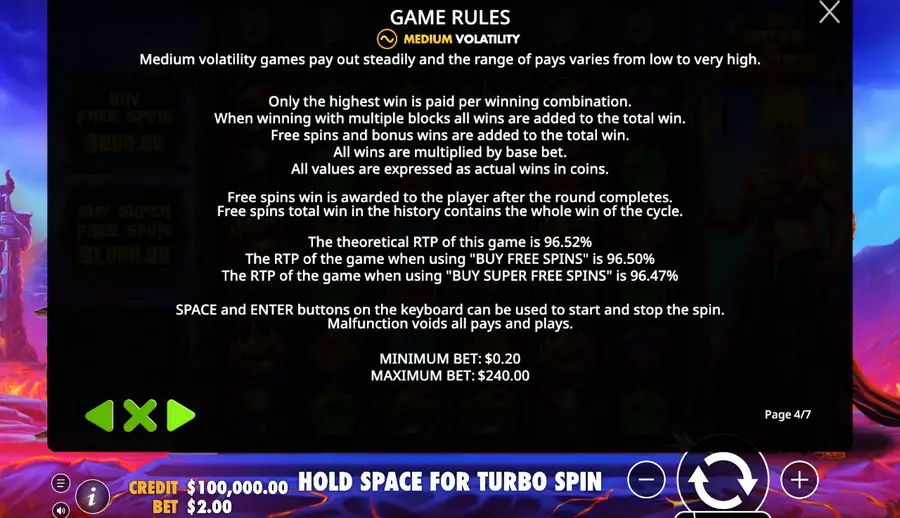
Return to player is the first figure a verdict has to get right. According to Pragmatic Play, this title publishes more than one return: 96.52%, 96.50% and 96.47%, depending on how a round is entered, so these reviews name which of them applies before quoting a number. Third-party catalogues additionally list 95.47% and 94.47%, which Pragmatic Play does not publish for this title, so these reviews credit those figures to the catalogues instead of to the studio.
The client states the win ceiling as 10,000x the bet, a hard cap that applies in both the base game and the free spins round, and that is the figure the reviews here are written against. We scored both pages against it. Neither quotes a ceiling the provider has never published.
Pragmatic Play runs the free demo where we wrote both verdicts. It needs no account, no deposit, and no bonus code. Opening it costs nothing, which makes it the cheapest way to test any claim we make.
Registers Before Animation
That is why the legitimacy page reads licences, stake limits, and withdrawal terms before it looks at a single animation. We check every licence number in the regulator's own register. A badge on a homepage proves very little by itself.
Regional Fit
Regional blocks decide whether any of this reaches a given country at all. If an operator shuts a country out, a return figure does that country no good, so each verdict says where the game opens and where it does not.
- Honest cons, the real cost of a bonus in wagering terms, and one named alternative.
- A visible score in the opening paragraph and again in the closing verdict.
How This Section Verifies a Figure
A recommendation has a measurable consequence. So we publish the scoring rubric, weight all four criteria equally, spell out on the method page what evidence each one accepts, and print our disagreements with third-party catalogues instead of quietly smoothing them over.
A check date promises one thing only: somebody opened that source on that day. So a correction moves the update date of the page it touches, and we fix the ledger in the same pass. How we test sets out the full method, including how we score and what we refuse to publish.
We are an affiliate publisher. We disclose that beside every sponsored link, and no operator buys a kinder write-up. Local law decides whether you can open an account at all, and the operator enforces its own identity checks, so nothing on these reviews is legal advice for any country.
Reading Order: Verdict First, Safety Second
Reading order matters here: deciding whether to play at all is one question, and deciding where to play is another. Read Legitimacy Check and Where to Play in that order. The verdict says whether the game earns the time, while the safety check says which lobby, if any, deserves a deposit.
A review is a snapshot, though, and operators revise terms without notice. Read the operator page and the responsible gambling limits before any deposit. The free demo needs no sign-up, so an account can wait until you have read those terms.
Pages most readers open first:
- our review and score
- the free demo, round by round
- the published RTP range
- is it legit: our licence check
- the casinos we checked
- how the game is actually played
Known Limits of These Verdicts
The verdicts here offer a judgement, a score, and a licence check. They do not offer a predictor, a pattern, or any system that claims to beat a certified random number generator, because no such system exists and a page selling one is selling you.
One more limit belongs on the record. We scored from recorded demo sessions, not from a real-money bankroll, so nothing here measures what a long losing run feels like with your own money on the table.
- No first-hand real-money testing is claimed anywhere in this section.
- Figures move: an operator may reconfigure return, limits, or availability after a page was written.
Gates of Hades Page Index and Dates
2 reviews, 2 of them scored out of 10, published between and .
| Page | Type | Score | Published |
|---|---|---|---|
| Is Gates of Hades Legit? What You Can Actually Verify | Review | 5.3/10 | |
| Where to Play Gates of Hades: What We Could Confirm | Review | 4.5/10 |
Every number on these reviews answers to one ledger, printed in full on the Reference section instead of repeated in each section.
Legitimacy Check
Two things are true at once. Filed as a review page, first published on .
What the Page Settles
The studio behind the game is licensed, and clean in every register we opened on the day we checked.
The game itself ships without a certificate you can look up. Our verdict: 5.3 of 10 on verifiability. The provider's British licence checks out, but no lab certificate covers this title and the fair-play claim is false.
The full working, with its sources, sits on Legitimacy Check.
| Field | As recorded |
|---|---|
| Type | Review |
| Our score | 5.3 / 10 |
| Published | |
| Last edit | |
| Read it | Legitimacy Check |
Where to Play
You can verify that a casino carries this game before depositing a rupee, and the method takes about ten minutes. A review entry; its last edit is dated .
Where Its Figures Come From
Six brands went through that check in a single afternoon, and two of them answered cleanly.
Our verdict: 4.5 of 10. Two of the six casinos we examined could be confirmed to carry Gates of Hades, and one holds the game back from India.
Our game notes, with their sources, are written up on Where to Play.
| Field | As recorded |
|---|---|
| Type | Review |
| Our score | 4.5 / 10 |
| Published | |
| Last edit | |
| Read it | Where to Play |
The documents behind these reviews — provider pages, operator terms and regulator registers — are listed with their check dates on the Reference section.